
When tailored software becomes a practical approach for SMEs to move beyond disconnected DIY tools without enterprise-level complexity.
Discuss your goals, requirements, and available options — with no obligation.
Why SMEs outgrow early operational tools.
As SMEs grow, many discover that off-the-shelf tools no longer support the way their business actually operates. Improving operational efficiency in business often requires moving beyond disconnected tools and creating structured software systems that support clearer workflows, better visibility, and sustainable growth.
However, this challenge often begins much earlier than expected. From early-stage startups to established SMEs, businesses frequently build operations around whatever tools are quickest to adopt, rather than what will remain sustainable over time. This creates a structural issue: operational foundations are often temporary from the outset.
Instead of designing software systems for business that scale with the organisation, many companies begin with tools that eventually need replacing.
As a result, teams become dependent on workarounds, manual coordination, and disconnected processes that slow down execution as the business grows.
The impact of fragmented systems on operational efficiency.
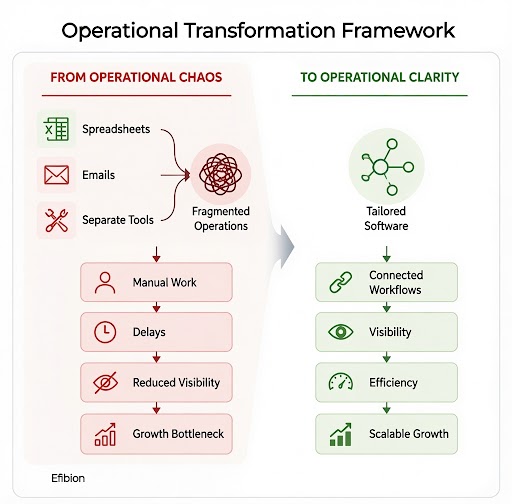
Many businesses end up managing multiple tools across departments for approvals, reporting, workflows, customer data, operations, and internal communication. Over time, this leads to fragmented processes, duplicated work, inconsistent data, reduced operational clarity in the workspace, weak oversight, and increasing reliance on external providers.
What starts as flexibility gradually turns into operational fragmentation. As the business scales, these inefficiencies compound and begin to limit performance.
For many growing organisations, improving operational efficiency in business requires moving beyond disconnected tools and creating structured workflows supported by connected software systems.
Finding the practical middle ground with tailored business software systems.
The cost of custom software varies significantly depending on the complexity of the system. In the London market, focused internal tools can commonly cost around £10,000–£40,000, while more complex business applications can reach £60,000–£100,000 or more.
For an SME, this can make a full software build a substantial upfront investment. At the other end, relying on multiple specialist software subscriptions can also become costly over time. For example, a £1,800 monthly subscription represents £21,600 per year, before taking into account additional software, integrations, implementation, support, or future price increases. For many SMEs, the real decision is not between basic tools and large-scale bespoke systems.
There is a practical middle ground. Tailored software can provide systems designed around specific business workflows without requiring a large enterprise-level investment. It can use the same established programming languages and technologies as custom and bespoke software, including Python, JavaScript, SQL, HTML, CSS, Bootstrap, PostgreSQL, SQLite and MongoDB rather than relying solely on pre-defined software builders. It can also integrate with existing business services and platforms, such as HubSpot, Google Calendar, email services, payment systems, and other business applications, allowing information and workflows to move between systems without unnecessary manual work.
The system is designed around how the business operates, but delivered in a phased and commercially realistic way. This means businesses do not need to commit to a large transformation project upfront. Instead, they can begin with core operational areas where software can create the greatest value and gradually build a connected system as their requirements develop.
How tailored software improves workflows and operational clarity.
Rather than continuing to add disconnected tools, businesses can unify workflows, approvals, operational data, and reporting through connected web application software designed around their operational needs.
Teams operate through a central system that connects departments, automates coordination, and provides real-time visibility across the organisation. These systems can include workflow automation, custom integrations, and purpose-built applications that reduce manual coordination and support more efficient daily operations. This reduces the need to switch between systems or rely on manual coordination.
The result is clearer accountability, better visibility, and more consistent operations.
Tailored systems also improve governance and long-term control. Businesses retain ownership of their operational data, reduce reliance on external providers, and gain flexibility to evolve processes over time.
Security permissions, audit trails, and oversight can be aligned directly with business needs rather than software limitations.
This is particularly important for organisations handling sensitive operational, financial, or customer data.
Gain Clarity on Your Next Steps.
From operational friction to scalable growth.
The success of tailored systems is measured through practical outcomes rather than technical complexity.
Teams adopt processes more effectively because systems are built around how they already work. Businesses experience fewer manual tasks, faster approval cycles, fewer errors, and reduced operational delays.
Financially, organisations benefit from improved efficiency and better long-term return on investment, often alongside a gradual reduction in unnecessary tooling costs.
More importantly, leadership gains clearer visibility into performance and operational health across the business.
As operations become more structured and scalable, businesses gain stronger governance, improved visibility, reduced dependency on disconnected tools, and greater internal efficiency.
Over time, this creates a meaningful operational advantage that generic tools often cannot deliver.
Tailored software allows SMEs to build systems that reflect how the business actually works. Instead of forcing teams to adapt to external tools, the technology is shaped around the organisation’s processes, goals, and growth plans.
This is the shift from using tools to designing operations.
The cost of staying with disconnected systems.
The financial impact is also significant. SMEs can easily spend £30,000+ per year across subscriptions, manual administration, duplicated effort, and inefficient workflows.
Additional costs arise through delays, operational bottlenecks, errors, and the ongoing effort required to maintain disconnected systems.
However, the most important cost is often less visible: reduced agility, slower decision-making, and limited operational visibility.
Without structural change, fragmented systems eventually become a ceiling on growth, affecting efficiency, customer experience, and profitability.
Explore guidance tailored to your business.
Building software systems around how your business operates.
This type of solution is typically delivered by full-stack technology partners specialising in software systems development, web application development, and integrated business systems that connect operational workflows, applications, and data-driven solutions within a structured environment.
The process usually begins by identifying operational bottlenecks, reviewing existing systems, and defining how information, workflows, and reporting should support day-to-day business activities.
Rather than pursuing large-scale transformation projects, businesses can take a phased approach, introducing practical improvements that increase visibility, streamline coordination, and create a stronger foundation for sustainable growth over time.
Get this article as a PDF.
Access practical guidance, actionable insights, and structured resources to support informed business decisions.
Turn your ideas into an actionable plan.