
From manual reporting and intuition-based decisions to predictive analytics, automation, and data-driven operations.
Discuss your goals, requirements, and available options — with no obligation.
Why SMEs struggle to turn business data into actionable insights.
For many SMEs, business systems were originally designed to record information rather than interpret it. Through AI integration in business, organisations can use machine learning to improve data visibility, generate meaningful business insights, and make better-informed operational decisions without replacing their existing systems.
Tools such as spreadsheets, CRM systems, and operational software store data effectively, but they often provide limited support for analysing information, identifying patterns, and creating actionable business insights in real time.
The cost of disconnected data infrastructure and manual analysis.
As a result, decision-making still depends heavily on manual review, reporting, and interpretation.
This creates a growing gap between the amount of data businesses collect and the value they gain from their data infrastructure and analytics, making it harder to improve business intelligence and operational decision-making.
Alongside this, many SMEs rely on disconnected tools and manual reporting processes to understand operations. This leads to delayed decisions, inconsistent reporting, duplicated data, and limited visibility across the business. Without connected data infrastructure, businesses often struggle to produce reliable business insights, identify trends, and make timely operational decisions.
How machine learning powers AI-driven business intelligence.
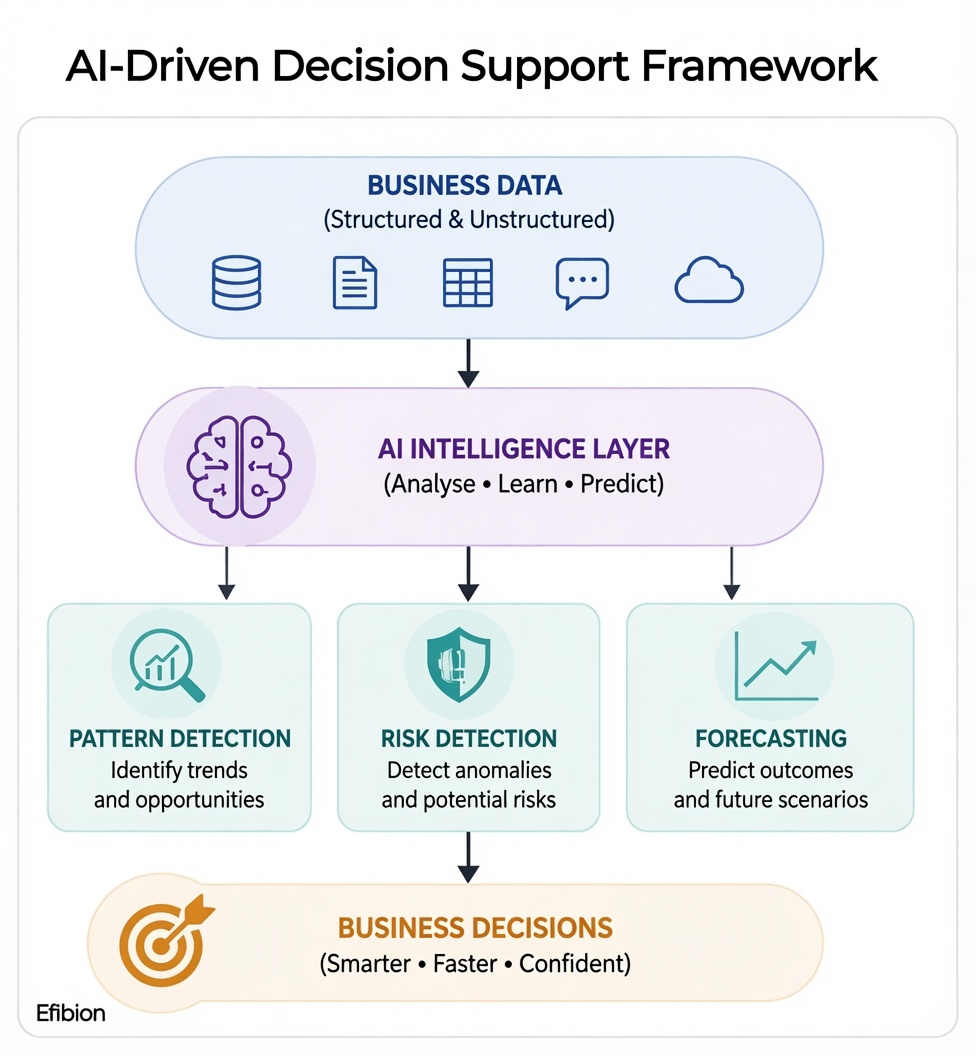
AI systems powered by machine learning help businesses move from intuition-based decisions to evidence-led decision-making. They allow systems to learn from historical and operational data rather than simply presenting information. Machine learning models can analyse business data, identify patterns, highlight risks, surface relevant insights automatically, improve predictions, and generate increasingly accurate results over time.
For SMEs, AI integration does not necessarily mean developing an entirely new AI platform. Depending on the business requirements, an AI or machine learning integration project can range from several thousand pounds for a focused solution to £20,000–£50,000 or more for more complex systems involving data processing, predictive models, integrations, and automation. The important consideration is whether the expected operational value justifies the investment. Programming languages and technologies such as Python, SQL and cloud services can be integrated with existing applications, APIs, databases, and business workflows.
This allows businesses to:
- understand operational issues faster
- identify risks earlier
- reduce time spent on manual analysis
- improve consistency in decision-making
Machine learning also enables predictive analytics models, allowing businesses to forecast demand, anticipate operational risks, and identify emerging opportunities before they affect day-to-day performance.Importantly, this is not about replacing existing systems. Instead, AI integration adds an intelligence layer that connects existing workflows, improves business intelligence, and supports better day-to-day operational decisions.
From manual reporting to AI-powered decision support.
One of the most practical benefits of AI is reducing manual effort in analysis and reporting.
Tasks such as monitoring performance, forecasting trends, and reviewing operational data can be partially or fully automated using AI and machine learning, significantly reducing manual analysis.
AI also improves consistency by applying structured logic across the business. This reduces variation in decisions and improves reliability across teams and processes. Advanced data processing capabilities allow organisations to analyse increasing volumes of information while maintaining consistent reporting and stronger operational control.
Over time, this leads to more stable operations and clearer coordination across the organisation.
Gain Clarity on Your Next Steps
Building scalable operations through intelligent data and analytics.
Traditional systems focus mainly on recording what has already happened. AI and machine learning introduce the ability to analyse historical data, recognise trends, and anticipate what is likely to happen next.
This includes identifying trends in demand, customer behaviour, operational performance, and potential risks using predictive analytics models that continuously improve as more business data becomes available.
For SMEs, this shift enables more proactive management rather than reactive problem-solving.
At the same time, AI and machine learning systems can process increasing volumes of operational data, identify meaningful patterns, and support better decision-making without increasing manual workload.
These systems also improve consistency and control by reducing human error and strengthening governance across decision-making processes.
Over time, businesses that adopt AI-driven systems benefit from:
- faster and better-informed decisions
- reduced manual workload and improved operational efficiency
- data visibility and business insights
- stronger use of existing data
- more scalable operations
When decision-making starts limiting growth.
The challenge is often not a lack of information, but a lack of visibility and connection between systems, processes, and workflows.
When information is fragmented across multiple tools, spreadsheets, and manual processes, decision-making becomes slower, operational visibility decreases, and administrative effort continues to grow as the business expands.
Over time, this can reduce efficiency, limit scalability, affect customer experience, and make it harder for the organisation to respond proactively to change.
As businesses grow, operations should become more structured and predictable — not increasingly complex and difficult to control.
Explore guidance tailored to your business.
Turning existing systems into intelligent operations through AI integration.
A common misconception is that AI requires complete system replacement. In practice, the most effective approach is integration.
AI enhances existing business tools by connecting with existing workflows and data sources, allowing information to be processed, analysed, and transformed into actionable operational intelligence through machine learning. This creates a practical middle ground between basic tools and complex enterprise-level solutions, allowing SMEs to increase capability without unnecessary disruption.
A structured implementation approach begins by identifying where operational decisions rely heavily on manual analysis, disconnected reporting, or fragmented information sources. Rather than replacing technology unnecessarily, businesses can focus on connecting processes, improving data visibility, and introducing intelligence where it delivers the greatest operational value.
This phased approach helps organisations make better-informed decisions, reduce manual effort, improve business intelligence and analytics, and build a stronger foundation for scalable growth through AI integration and machine learning.
For organisations looking to unlock greater value from their existing systems, partnering with specialists in AI integration, machine learning, and data infrastructure can provide a practical route to better operational intelligence without unnecessary complexity.
Get this article as a PDF.
Access practical guidance, actionable insights, and structured resources to support informed business decisions.
Turn your ideas into an actionable plan.