
How SMEs can reduce manual work and improve visibility without replacing existing systems they already use.
Discuss your goals, requirements, and available options — with no obligation.
Why SMEs struggle to improve operational efficiency despite using digital tools.
Many SMEs already use a range of digital tools across their business, yet everyday operations still rely heavily on spreadsheets, email chains, shared documents, phone calls, and manual follow-ups. Improving operational efficiency in business often starts by reducing manual work, strengthening digital business capabilities, and creating better visibility across existing processes. This is especially common in growing businesses where systems are added gradually over time.
Teams often adopt whatever tools solve an immediate problem, but as operations expand, these disconnected processes become harder to manage efficiently and limit the ability to build stronger digital business capabilities.
The result is operational friction: delays, duplicated work, inconsistent processes, and limited visibility across the business, making it harder for leaders to access reliable business insights and make informed decisions.
In many cases, the issue is not a lack of technology. The issue is that existing tools were never designed to work together as part of a connected operational system.
Reducing manual work and improving operational efficiency.
As businesses grow, manual coordination becomes increasingly expensive.
Teams spend large amounts of time chasing approvals, updating spreadsheets, re-entering data, searching for information, and coordinating tasks between departments instead of focusing on higher-value activities.
This creates dependency on manual effort instead of reliable operational systems. By introducing connected workflows, software integration, and automated processes, SMEs can reduce unnecessary administration while improving operational efficiency across the organisation.
Over time, inefficiencies compound across the organisation:
- approvals slow down
- reporting becomes inconsistent
- operational bottlenecks increase
- errors become harder to track
- accountability becomes unclear
For many SMEs, these inefficiencies can quietly cost between £20,000 and £100,000 per year through lost productivity, duplicated effort, delays, and operational inefficiency.
Digitalisation for SMEs: strengthening existing business systems without full replacement.
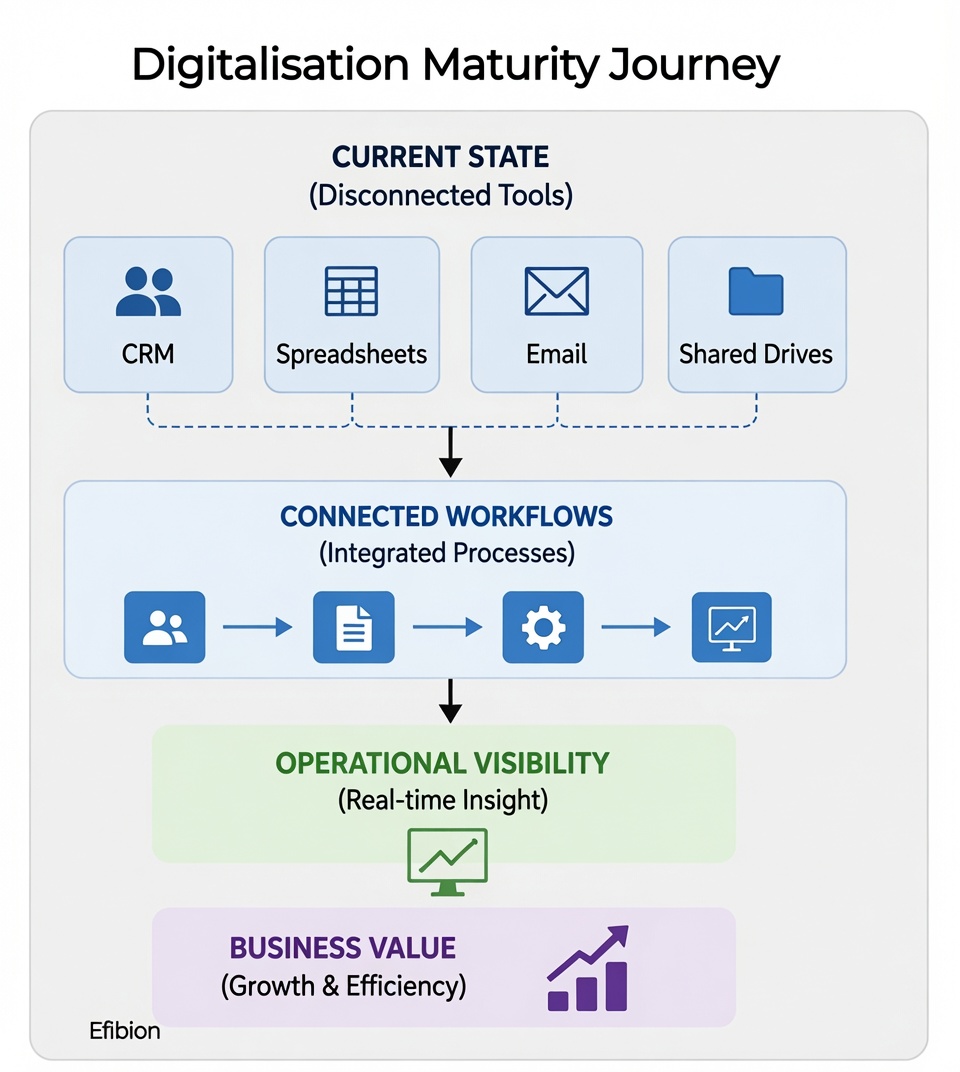
Many business owners assume digitalisation means replacing all existing tools with expensive enterprise systems. In reality, most SMEs do not need large-scale enterprise software or complex transformation projects. Development and implementation costs can quickly reach tens of thousands of pounds for larger software projects, while adding multiple SaaS platforms can create significant recurring costs.
A more practical approach is to improve the value of existing systems by connecting workflows, integrating business applications, reducing manual coordination, and gradually improving inefficient processes over time. Even familiar cloud services such as Google Drive can form part of this digital environment by giving teams shared access to documents, spreadsheets, and business information.
However, as operations become more complex, businesses may need to go further by connecting these tools with applications, databases, APIs, and automated workflows. This can involve programming languages and technologies such as Python, JavaScript, SQL, Django, React, and APIs, depending on the existing business environment and requirements.
This creates a middle ground between disconnected DIY operations and expensive enterprise-level implementations.Instead of forcing businesses to completely rebuild how they work, digitalisation helps SMEs create more structured operations around the tools and processes they already use.
Automating business workflows and creating connected operations.
Digitalisation allows businesses to move from reactive coordination towards structured operational management.
Instead of relying on email chains, spreadsheets, and informal approvals, teams work through connected workflows with clearly defined responsibilities, approval stages, and operational visibility.
Tasks can move automatically between departments based on business rules, reducing delays, improving accountability, and creating more consistent business workflows.
Operational data becomes easier to track, approvals become more transparent, and reporting becomes more reliable.
Rather than manually preparing static reports, leadership gains access to real-time operational visibility across workflows, bottlenecks, approvals, and business performance.
This allows businesses to make decisions faster and manage operations more proactively. Combined with business intelligence and analytics, connected operational data helps SMEs identify trends, monitor performance, and uncover opportunities for improvement.
Gain Clarity on Your Next Steps
Building scalable business operations through digitalisation.
The real value of digitalisation is not simply automation. It is operational clarity, improved data visibility, and better control over how work moves through the business.
As businesses replace fragmented manual processes with connected workflows, teams spend less time managing administration and more time focusing on customers, growth, and delivery.
Businesses gain:
- improved operational visibility
- reduced manual workload
- faster approvals and coordination
- stronger process consistency
- better governance and accountability
- more scalable day-to-day operations
Most importantly, operations become easier to manage as the business grows.
Digitalisation helps SMEs create a more connected, controlled, and scalable operational foundation — without unnecessary enterprise-level complexity.
The cost of maintaining disconnected operations.
Businesses that continue relying on spreadsheets, disconnected tools, and manual coordination often find that operational complexity increases faster than the business itself.
More importantly, leadership loses clear visibility into how work actually moves through the business.
Over time, this affects profitability, customer experience, scalability, and internal efficiency.
Explore guidance tailored to your business.
Getting more from the systems you already use.
This is where full-stack operational technology partners become valuable — helping businesses connect workflows, improve software integration, automate repetitive tasks, and create scalable operational systems.
For many SMEs, this may include improving existing business management software for small businesses rather than replacing their entire technology environment.
A structured approach begins by reviewing existing workflows, identifying operational bottlenecks, and understanding how information moves across the business.
Rather than replacing systems unnecessarily, businesses can focus on connecting processes, improving visibility, and reducing manual effort in a phased, commercially realistic way. This allows organisations to create more value from the tools they already use while building stronger foundations for future growth.
Get this article as a PDF.
Access practical guidance, actionable insights, and structured resources to support informed business decisions.
Turn your ideas into an actionable plan.