
Helping SMEs improve operational efficiency through secure cloud infrastructure and connected business systems.
Discuss your goals, requirements, and available options — with no obligation.
Why SMEs outgrow fragmented systems and need modern cloud infrastructure.
For many SME owners, technology should make the business simpler, not more complicated.
Cloud infrastructure services provide SMEs with a secure and scalable way to run core business operations—such as sales, workflows, reporting, and day-to-day administration—through connected online systems rather than relying on local files, manual processes, or disconnected tools.
As businesses grow, it is common for operations to become spread across spreadsheets, shared drives, messaging tools, and separate applications. While this often starts as a practical approach, it quickly leads to duplicated work, inconsistent information, and reduced control over how work is managed.
Without a connected cloud infrastructure, SMEs often rely heavily on manual coordination between teams, repeated data entry, and constant switching between systems that do not communicate effectively. These inefficiencies build up over time, creating delays, slowing decision-making, and creating operational friction that is not always immediately visible. Cloud consulting services can help businesses identify these operational bottlenecks and develop a structured migration strategy without disrupting day-to-day operations.
The hidden cost of disconnected business infrastructure.
The operational impact of fragmented systems is often underestimated.
When workflows are spread across multiple tools, businesses lose visibility over how work moves through the organisation. Disconnected data infrastructure also makes it more difficult to generate accurate reporting, business analytics, and reliable operational insights. Important processes become harder to track, approvals take longer, and accountability becomes less clear.
In many cases, SMEs spend significant time on manual coordination, searching for information, and correcting inconsistencies caused by duplicated or outdated data.
These inefficiencies quietly translate into real financial impact through lost productivity, delayed delivery, and avoidable operational overheads.
As the business grows, these challenges compound and begin to limit scalability and performance.
What cloud infrastructure services provide for SMEs.
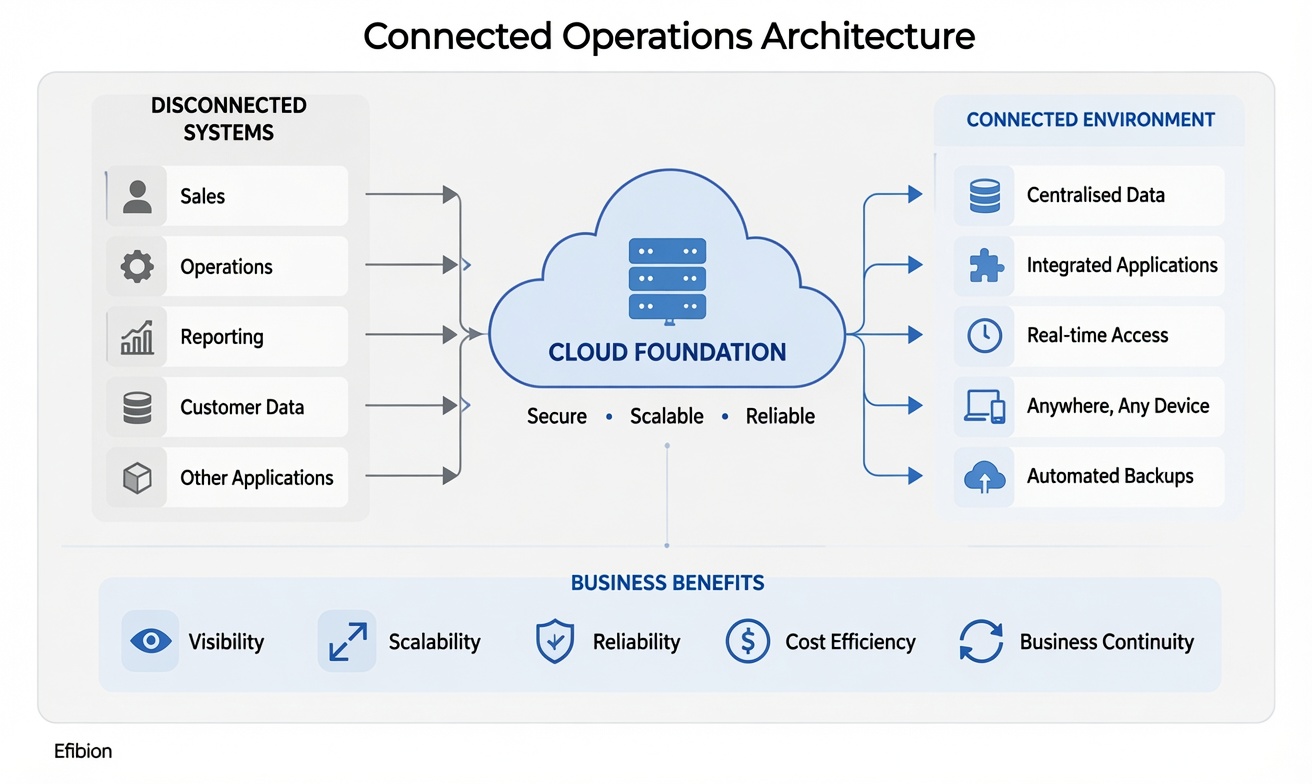
At its core, cloud infrastructure provides the foundation for secure cloud hosted applications, cloud hosted databases, and connected business systems that support long-term growth.Instead of managing physical servers or fragmented technical setups, businesses operate through a consistent environment where systems can run reliably and be accessed securely from anywhere.
For SMEs, cloud infrastructure costs are typically usage-based rather than fixed. With Amazon Web Services (AWS), for example, the cost can increase or decrease according to factors such as computing resources, storage, data transfer, and application traffic. This means businesses can start with infrastructure appropriate to their current requirements and scale it as usage grows, rather than making a large investment in physical infrastructure upfront.
Professional cloud infrastructure services can help organisations select and configure appropriate services, deploy applications and databases, and migrate existing systems while minimising operational disruption. This can provide the computing, database, storage, security, and deployment capabilities needed to run modern business applications reliably. AWS services such as EC2, Elastic Beanstalk, RDS, Aurora, S3, Route 53, AWS Certificate Manager, and Amplify can be selected according to the business requirements, rather than applying the same infrastructure to every organisation.
The aim is not simply to move software to the cloud, but to create a reliable infrastructure foundation that is appropriate for the business today and can scale as its users, traffic, data, and operational requirements increase.
From manual coordination to connected cloud-based workflows.
The true benefit of cloud adoption appears when business processes are properly connected.
Instead of relying on spreadsheets, emails, and informal communication, teams operate through structured workflows with clear steps, responsibilities, and visibility.
Tasks move more smoothly between departments, approvals become easier to track, and information remains up to date across the organisation.
This reduces duplication, improves accountability, and makes operations more predictable.
Cloud-based systems also allow businesses to centralise workflows, reduce dependency on disconnected tools, and improve operational efficiency across departments. This reduces administrative effort and improves operational clarity.
Over time, businesses gain stronger control over how work is executed and monitored, while teams spend less time coordinating and more time delivering value.
Gain Clarity on Your Next Steps.
Building scalable business operations with cloud infrastructure.
As operations become more structured, businesses gain improved visibility, faster execution, and more consistent performance.
Cloud infrastructure enables SMEs to scale through stronger enterprise infrastructure solutions, reducing operational complexity while supporting sustainable growth.
The success of this approach is measured through practical outcomes: reduced manual work, improved operational efficiency, stronger data visibility, faster processes, and more reliable day-to-day operations.
Ultimately, it is not just a technical improvement—it is a way of building a more controlled, efficient, and scalable business.
When operational complexity starts limiting business growth.
As organisations grow, disconnected systems often require increasing levels of manual coordination, oversight, and administration.
Businesses that continue relying on manual processes and disconnected tools frequently experience slower operations, reduced visibility, and increasing operational friction as complexity grows.
Over time, this can reduce efficiency, limit scalability, affect customer experience, and make operations more difficult to manage and control.
Cloud infrastructure helps address these challenges by providing a structured foundation that improves reliability, supports growth, and reduces the operational burden associated with managing technology.
Explore guidance tailored to your business.
Creating sustainable growth through cloud infrastructure.
Cloud infrastructure enables processes, applications, and data to become connected rather than isolated. This creates stronger data infrastructure solutions that improve collaboration, reporting, and operational visibility.
However, the real value of cloud infrastructure is not simply technical—it is operational. It enables businesses to improve operational efficiency, create consistent workflows, and build scalable foundations for future digital growth.
Many SMEs begin their cloud journey with individual services such as cloud-hosted applications or databases. As the business grows, these can evolve into fully connected cloud infrastructure that supports operational efficiency, business analytics, and long-term scalability.
Get this article as a PDF.
Access practical guidance, actionable insights, and structured resources to support informed business decisions.
Turn your ideas into an actionable plan.